AI SEO for Dentists: Do Dentists Really Need to Rank in ChatGPT in 2026?

Every week I get the same question from practice owners: "Do I need to show up in ChatGPT?" The short answer is yes, but probably not for the reason you think. AI search is not some parallel universe you need to conquer with a brand new strategy. It runs on the same trust signals, the same authority, and the same local relevance you have always needed. The difference is that AI tools now package and present that information directly to patients, and if your foundation is not solid, you are invisible before anyone ever picks up the phone.
AI SEO for dentists is a real category now, and the practices that understand it early will have a meaningful edge over those who either dismiss it as hype or chase it like a magic trick.
As VP of Marketing at Elevate DDS, a 15+ year leader in dental SEO and dental PPC, I have managed campaigns for practices across the country and watched search behavior change in real time. What I am seeing in 2026 is a genuine shift in how patients find dentists. It is not replacing Google. It is layering on top of it. And the practices that understand that distinction are the ones growing their patient base.
By the end of this post you will understand exactly what AI SEO for dentists means, how ChatGPT and Google AI Overviews actually decide which practices to recommend, and what you can do right now to make sure yours is one of them.
"Dentists do not need a ChatGPT ranking hack. They need to make their practice easier for AI systems to find, understand, trust, and recommend."
What Is AI SEO for Dentists?
AI SEO for dentists is the process of making your practice easier for AI-powered search tools like ChatGPT, Google AI Overviews, Gemini, Perplexity, and Bing Copilot to understand, trust, cite, and recommend when patients search for dental care.
That definition sounds simple, but it has real implications for how you manage your website, your Google Business Profile, your reviews, and your online directory listings. Traditional SEO was about getting Google to rank your pages. AI SEO is about making your practice legible to systems that synthesize information from dozens of sources and then present a single recommendation to the patient.
The person asking ChatGPT "who is the best Invisalign dentist near me" never sees the list of 20 websites the AI scanned. They see the practice that got recommended. That is the game.
Key Takeaway:
AI SEO for dentists is not a replacement for traditional dental SEO. It is the next layer of it. The fundamentals still apply, but the way your information gets cited and recommended has changed.
Why Dentists Are Suddenly Asking About ChatGPT Rankings
Search behavior is changing faster than most practices realize. ChatGPT launched web search features in late 2023 that actively crawl and cite websites, which means your practice's online presence now directly factors into what ChatGPT recommends. OpenAI has confirmed that their OAI-SearchBot is used to surface websites in ChatGPT search features, and they recommend allowing it in your robots.txt file to ensure your site can appear in results.
Most dental practices have never checked whether they are blocking this bot. If you are, ChatGPT cannot access your pages and cannot recommend your practice based on your website content. That is a simple, technical problem with a simple fix, and it is far more common than you would expect.
On the Google side, AI Overviews now appear at the top of the results page for a wide range of dental queries, frequently above standard organic listings and above paid ads. Patients can get a summary of "best Invisalign dentist near me" without clicking a single link. If your practice is not being cited in those summaries, you are not part of that conversation.
How Patients Are Actually Using AI to Find a Dentist
Not every patient is opening ChatGPT to book a cleaning. Let's be clear about that. But the patients using AI tools tend to be researching higher-value procedures, asking more specific questions, and further along in their decision making than your average Google searcher.
The queries that show up most often in AI search for dental practices:
- "Best Invisalign dentist near [city]"
- "Who does dental implants in [area] with good reviews"
- "Cosmetic dentist near me that does veneers and bonding"
- "How much does Invisalign cost in Los Angeles"
- "Dentist near me that accepts [insurance]"
These are not casual browsing searches. The person asking an AI chatbot about the best Invisalign provider near them is already considering treatment. They are doing final research before calling an office. If your practice does not come up in that answer, you do not get a chance to convert them.
Google's own guidance confirms that AI Overviews and AI Mode still rely heavily on standard SEO fundamentals: indexed content, crawlability, helpful content, structured data that matches what is visible on the page, and up-to-date Business Profile information. There is no secret back door for AI. The practices getting recommended are the ones that have done the foundational work.
How ChatGPT Chooses Which Dental Practice to Recommend
This is what every dentist actually wants to know, and the honest answer is: ChatGPT is not reading your website the way a person reads it. It is looking for signals that tell it your practice is real, credible, locally relevant, and trusted by patients. Here is what feeds that process.
Website crawlability
OpenAI's SearchBot needs access to your site. If you have a template website with thin content and no service-specific pages, the AI has very little to cite. Clear, written content about your services, your doctors, your procedures, and your location is what gets pulled. Images with no alt text, PDFs without text extraction, and JavaScript-dependent pages all create blind spots.
Your Google Business Profile
AI tools cross-reference GBP data constantly. Your practice name, address, phone number, hours, services listed, and photos all feed into whether an AI can confidently recommend you. Inconsistencies between your website and your GBP create doubt and lower your chances of being cited.
Reviews
ChatGPT and Perplexity both pull from review platforms. A practice with 500 five-star Google reviews and recent reviews mentioning specific procedures has a major advantage over a practice with 40 reviews and no recent activity. The substance of those reviews matters. If patients are mentioning "great Invisalign experience" or "Dr. [Name] made the process so easy," that context carries real weight in how AI systems characterize your practice.
Directory listings and citations
AI systems check multiple sources to verify that a business entity is what it claims to be. Consistent NAP (name, address, phone) across Yelp, Healthgrades, Zocdoc, and other directories signals legitimacy. Inconsistencies across those platforms lower AI confidence in your data.
Schema markup
Schema.org's Dentist type and MedicalService structured data tell AI tools exactly what your practice does, where you are, and what credentials your doctors hold, in a format they can read without guessing. Most dental websites have no schema at all, or outdated schema that does not match visible page content.
"AI tools do not reward hacks. They reward clarity. The clearer your practice information is across every platform, the more confident AI is when recommending you."
How Google AI Overviews Are Changing Dental SEO
Google AI Overviews are now a permanent feature of Google Search for most dental queries. They appear above paid ads for informational searches and above organic results for many local queries. The practical impact for dental practices is significant and breaks down like this.
Informational content is getting squeezed. Blog posts that answered "what is a dental implant" or "how long does Invisalign take" used to drive meaningful traffic to dental websites. Now Google summarizes that information directly in the AI Overview. Traffic to thin, purely informational content has dropped across many practices in our portfolio.
Local and transactional intent still works. When someone searches "Invisalign dentist Van Nuys" with intent to book, Google still prominently shows local results, the map pack, and paid ads. The AI Overview for local searches synthesizes reviews and nearby options, which means your GBP and review content are more important than ever, not less.
Being cited in AI Overviews is achievable. Google's documentation states that pages need to be indexed and eligible to show in standard Google Search to appear in AI Overviews. There are no special technical requirements beyond standard search eligibility. If your pages are indexed, well-structured, and authoritative, you are in the running.
What Is GEO, and Is It Different From Dental SEO?
GEO stands for Generative Engine Optimization. It is the practice of helping your dental business get recommended by AI tools like ChatGPT, Perplexity, and Google AI Overviews. You will also hear it called Answer Engine Optimization (AEO).
I want to be straight with you about this: GEO is not an entirely new discipline that replaces what you have been doing. It is an extension of dental SEO with a different output format. Instead of ranking a URL on page one, you are getting cited in an AI-generated response.
The signals that drive GEO are largely the same signals that drive traditional SEO: authority, relevance, accuracy, reviews, and technical accessibility. The meaningful difference is that AI tools need to extract and package your information quickly and confidently. That means your content needs to be written in a way a machine can read and cite clearly, not just in a way that looks good to a human reader scrolling through.
For dentists, the GEO framework is most useful for understanding why certain competitors show up in AI answers even when they do not rank higher in traditional Google results. Often it comes down to review volume, schema markup, and directory consistency, all of which are fixable.
The 7 Signals That Help Dentists Show Up in AI Search
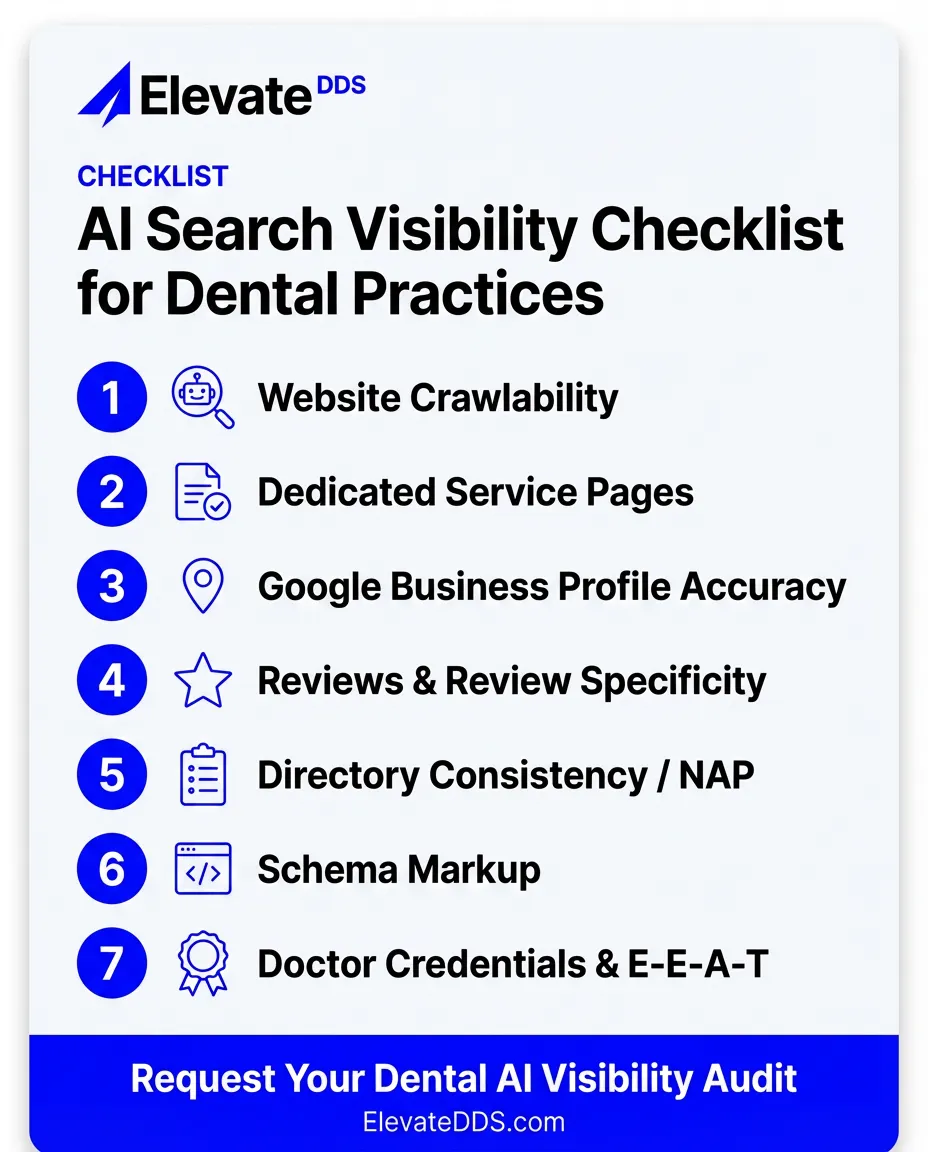
Based on the data I am seeing across our client portfolio and our AI tracking tools, these are the seven factors that most directly influence whether a dental practice gets recommended in AI search.
1. Website Crawlability. Confirm OAI-SearchBot is not blocked in your robots.txt file (visit yourdomain.com/robots.txt and check). Confirm all service pages are in your sitemap and indexed in Google Search Console. If AI tools cannot crawl your site, none of the other work matters.
2. Dedicated Service Pages. Every service you want to be known for needs its own page with genuine written content covering the procedure, who it is for, what to expect, and why your practice is the right choice. A single page listing 15 services in three sentences does not get cited.
3. Google Business Profile Accuracy. Every field should be complete and current: business name, address, phone, website, hours, services, photos, and regular posts. AI tools cross-reference GBP data constantly, and inconsistencies lower your visibility score.
4. Reviews and Review Specificity. Volume matters. Recency matters. But what patients say in those reviews is what gives AI tools the topical signal to match you to specific queries. A practice with 400 reviews where 50 specifically mention Invisalign will outperform a competitor with 800 reviews of generic praise when patients ask about Invisalign providers.
5. Directory Consistency. Your NAP should be identical across Google, Yelp, Healthgrades, Zocdoc, Vitals, and local directories. Inconsistencies signal unreliable entity data and reduce AI confidence.
6. Schema Markup. Dentist schema, MedicalService schema, FAQPage schema, and LocalBusiness schema help AI tools understand your practice without guessing. You can test your current schema using Google's Rich Results Test. Most dental websites have zero working schema.
7. Doctor Credentials and E-E-A-T. AI tools weight experience, expertise, authority, and trust heavily for healthcare content. Doctor bio pages, years in practice, specialty certifications (Platinum Invisalign Provider, board certifications, etc.), continuing education, and any mentions of your practice on other authoritative sites all contribute.
Do Reviews Help Dentists Rank in AI Search?
Yes, and they matter more in AI search than in traditional SEO for one specific reason: AI tools read and synthesize review content, not just star ratings.
When ChatGPT or Perplexity is asked about the best Invisalign dentist in a given city, it pulls from multiple sources: your website, your GBP, your reviews, and third-party directories. If recent reviews specifically mention Invisalign, clear aligners, transformation stories, or a doctor's name and expertise, those reviews become citations that reinforce your relevance to that exact query.
A practice with 50 reviews averaging 4.9 stars and no procedure-specific language will often lose to a competitor with 200 reviews where 30 of them specifically mention Invisalign, dental implants, or cosmetic work. The AI reads both practices as trustworthy, but only one gets surfaced for specific treatment queries.
This is why reputation management is no longer just about maintaining a good Google rating. It is about the richness and relevance of what patients say when they leave that review.
Key Takeaway:
Coach patients to mention the specific procedure in their review. Not just "great experience" but "my Invisalign treatment with Dr. [Name] took 12 months and I could not be happier with the results." That specificity is what AI systems cite when recommending you for Invisalign queries.
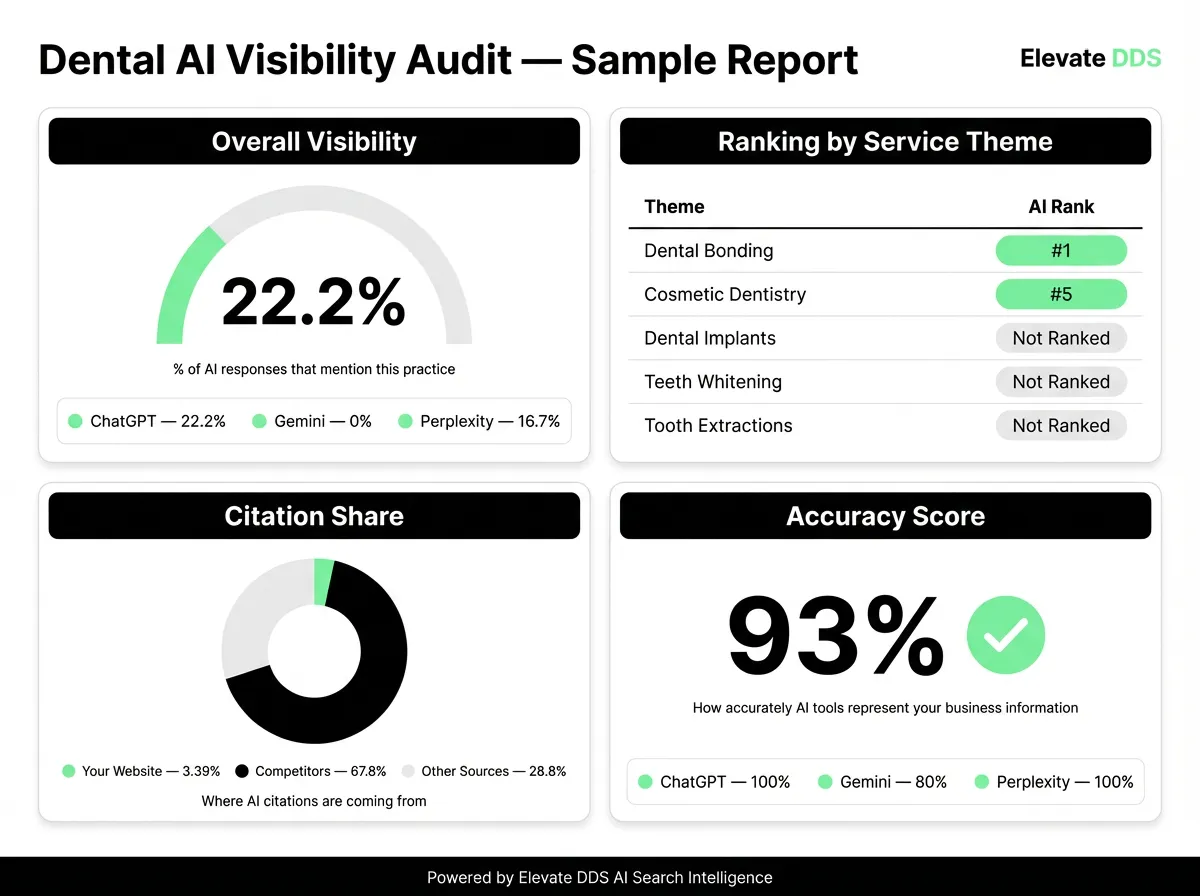
"The gap between this practice's clinical reputation and their AI visibility was significant. They were not being ignored because they were not excellent. They were invisible because AI tools could not read the evidence of that excellence."
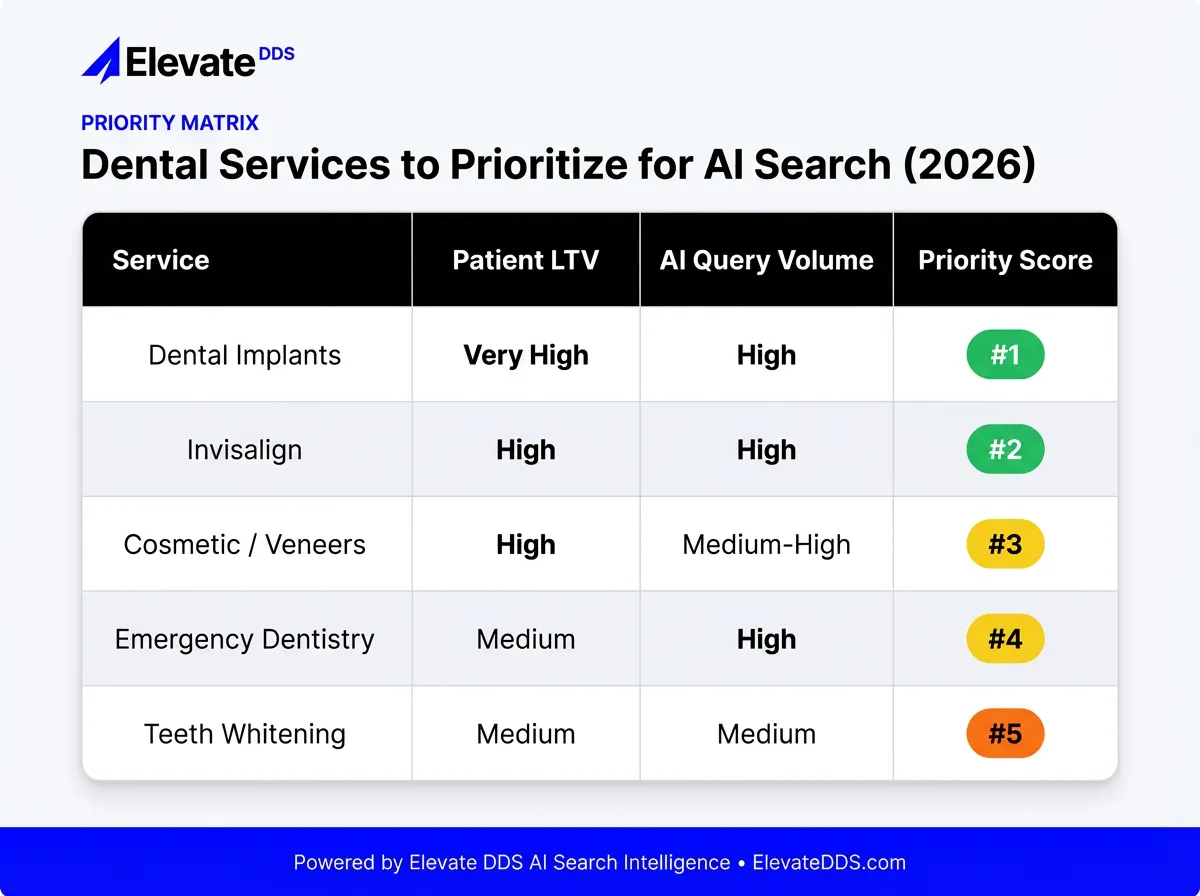
Which Dental Services Should You Prioritize for AI Search?
Yes, and they matter more in AI search than in traditional SEO for one specific reason: AI tools read and synthesize review content, not just star ratings.
Not every service needs an AI SEO push on day one. Start where patient lifetime value is highest and where AI search volume is most competitive.
Dental Implants. High value, long research phase, and patients commonly use AI to compare providers and pricing before ever calling an office. A strong implant page with schema, reviews mentioning implant experiences, and a complete GBP with implant services listed can produce significant results.
Invisalign and Clear Aligners. Patients research Invisalign extensively before committing. AI tools frequently field questions like "best Invisalign provider near [city]" and pull from reviews, websites, and directories to answer. Platinum and Diamond Provider status is exactly the kind of verifiable credential AI tools look for when deciding who to recommend.
Cosmetic Dentistry (Veneers, Bonding, Smile Makeovers). Emotionally driven and research-heavy. Patients asking AI tools about cosmetic dentistry want a curated recommendation, not 10 blue links. A practice with strong cosmetic content, specific patient reviews, and clear before-and-after context has a real advantage.
Emergency Dentistry. High urgency means high AI query volume. "Emergency dentist near me open now" is increasingly being asked through AI assistants. Your GBP hours and emergency service page need to be accurate, indexed, and written clearly for this to work.
Is AI SEO Replacing Traditional Dental SEO?
No. I want to say this directly because the marketing space is noisy right now about "SEO being dead" thanks to AI.
Traditional dental SEO still drives local visibility, map pack rankings, paid search quality scores, and organic traffic from patients who prefer to do their own research. What has changed is that SEO now has a second output format: AI citations. A well-optimized dental website that ranks in traditional Google search is also better positioned to get cited in AI search. They are not separate games.
What is changing is the type of content that gets results. Thin, keyword-stuffed service pages that ranked in 2019 are not getting cited in AI Overviews. Content with genuine depth, local specificity, doctor credentials, patient education, and accurate structured data is. That is good news for practices that invest in quality over quick wins.
Key Takeaway:
The practices getting squeezed by AI search are the ones that relied on shortcuts. The practices getting cited are the ones that built something real. Foundational dental SEO and AI SEO point in the same direction.
What Should Your Practice Do Right Now?
If you are not sure where to start, here is the sequence I would follow.
Step 1: Check your robots.txt. Go to yourdomain.com/robots.txt. Look for any rules blocking OAI-SearchBot or Googlebot. If ChatGPT cannot crawl your site, it cannot recommend you. This takes five minutes to check and fix.
Step 2: Audit your Google Business Profile. Every field should be complete and accurate. Hours, services, phone, website, and photos. Log in and review it today. AI tools rely on GBP data more than most practices realize.
Step 3: Read your recent reviews. How many specifically mention the procedures you most want to be known for? If the answer is very few, start coaching patients before they leave the office. Give them a specific, gentle ask: "Would you mind mentioning your Invisalign experience in your Google review?"
Step 4: Test your schema. Use Google's Rich Results Test to see what structured data your site is currently returning. If nothing comes back, or if it is incomplete, that is a high-priority fix.
Step 5: Audit your service pages. Does each procedure you offer have a dedicated page with real written content? Does it mention your doctor by name? Does it include local relevance? A clear call to action? If not, that is your content roadmap for the next 90 days.
Ready to know exactly where your practice stands in AI search? Request a Dental AI Visibility Audit. We check your website, Google Business Profile, reviews, citations, service pages, and AI search presence across ChatGPT, Gemini, and Perplexity, then show you specifically where your practice is visible, missing, and being outranked. Our VP of Marketing, David, will personally review your results and build a custom strategy for your practice.
Frequently Asked Questions: AI SEO for Dentists
What is AI SEO for dentists?
AI SEO for dentists is the process of making your practice easier for AI-powered tools like ChatGPT, Google AI Overviews, Gemini, and Perplexity to understand, trust, and recommend when patients search for dental care. It builds on traditional dental SEO but focuses specifically on how AI systems find, package, and cite your practice.
How do dentists show up in ChatGPT?
ChatGPT uses its OAI-SearchBot to crawl websites and cross-references review platforms, directories, and structured data. Practices with indexed websites, strong reviews, accurate Google Business Profile listings, and clearly written service pages are most likely to be recommended.
Can ChatGPT recommend my dental practice?
Yes. OpenAI's search features actively crawl and cite dental practice websites. The more complete, accurate, and authoritative your online presence, the more likely ChatGPT is to surface your practice for relevant queries.
Do Google reviews affect ChatGPT recommendations?
Yes. ChatGPT and other AI tools pull from review platforms when evaluating local businesses. Review volume, recency, and the specific services mentioned in reviews all influence which practices get recommended for specific queries.
What is GEO for dentists?
GEO stands for Generative Engine Optimization. It is the practice of making your dental business easy for AI-powered search tools to find, cite, and recommend in generated responses, as opposed to traditional ranked links. It is an extension of dental SEO, not a replacement for it.
Is GEO replacing SEO for dentists?
No. GEO and traditional dental SEO rely on the same foundational signals: indexed content, local authority, reviews, and technical accessibility. The difference is the output. SEO targets ranked URLs. GEO targets AI citations. Both still matter.
Should dentists allow OAI-SearchBot?
Yes. OpenAI has confirmed that OAI-SearchBot is used to surface websites in ChatGPT's search features. Allowing it in your robots.txt file means ChatGPT can access and recommend your practice based on your website content.
What is the difference between SEO and AI SEO for dentists?
Traditional SEO focuses on ranking web pages in Google's blue link results. AI SEO focuses on making your practice easy for AI tools to cite in generated answers. Both share the same foundational signals, but AI SEO places extra emphasis on schema markup, review specificity, entity accuracy across directories, and content that machines can read and extract clearly.
How can I tell if my dental practice shows up in AI search?
You can test manually by asking ChatGPT, Gemini, and Perplexity questions like "best Invisalign dentist near [your city]" and checking if your practice is mentioned. For a comprehensive audit with visibility scores, ranking data, citation analysis, and competitor benchmarking, request an AI Visibility Audit from our team.
What should dentists do now to prepare for AI search?
Start by confirming OAI-SearchBot is allowed in your robots.txt. Audit your Google Business Profile for completeness. Read your recent reviews for procedure-specific language. Test your schema markup. Ensure each service you offer has a dedicated, well-written page with accurate structured data.
Need to speak with an expert?
Maximize your practice's efficiency today by scheduling an appointment with one of our experts. We're standing by to help you in your journey of elevated practice growth.
Drop Knowledge
Share these Elevated Insights with your professional network.
Elevated Insights
Dive into our other blog posts featuring creative ways to elevate your practice and dominate your service area.